
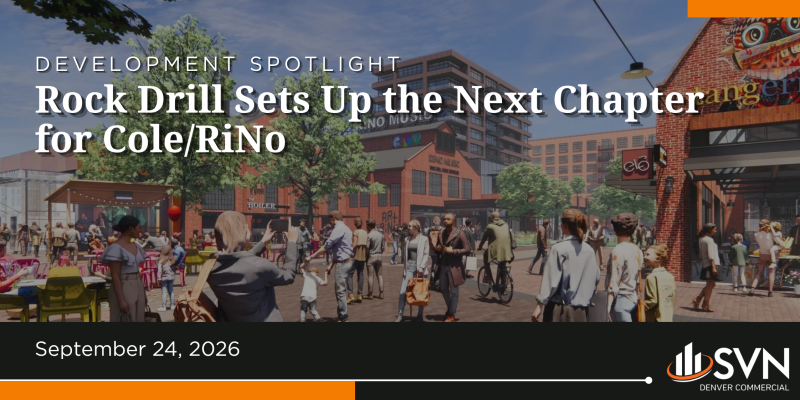
6.7 acres. Up to 16 stories. Up to $39M in tax-increment support. 700 to 800 homes. One century-old sawtooth campus. Rock Drill is entitled, and the story now shifts from approvals to execution.
At SVN Denver, we track the deals and entitlements that move a submarket before they show up in the headlines. Rock Drill is the redevelopment of the former Denver Rock Drill Manufacturing Co. at 1717 East 39th Avenue. It’s one of north Denver’s most consequential adaptive reuse plays, and the entitlement and rezone process was completed on September 15, 2025, a year ago this month. We’ve watched a similar mix of legacy-site reuse and public gap financing at Mineral Place in Littleton. Rock Drill brings that pattern to one of the city’s most transit-connected industrial sites.
| Address | 1717 E. 39th Ave., Denver (Cole/RiNo), between Franklin and Williams streets |
| Site size | 6.7 acres |
| Zoning | Heavy industrial to mixed-use, requested as C-MX-12 and C-MX-16; up to 16 stories |
| Program | 700–800 residential units; up to 60,000 SF office, 150,000 SF retail; 150–220-room hotel; about 71,000 SF of outdoor public space |
| Affordability | 10% of units reserved at 50% AMI |
| Est. project cost | Nearly $585M |
| Public support | Up to $39M in TIF through the Denver Urban Renewal Authority |
| Developer | OliverBuchananGroup, working with the Weiss family |
| Transit | A couple of blocks from the 38th & Blake rail station |
What Council Approved
On Sept. 15, 2025, Council approved a rezoning, a development agreement and tax benefits for the project. The package also included an urban redevelopment plan and a city–DURA cooperation agreement authorizing the TIF. Developers also waived the option to pay a fee in lieu of the affordable housing requirement, so the income-restricted homes have to be built on-site. That’s a meaningful commitment in a submarket where fee-in-lieu is often the path of least resistance.
Site Plan
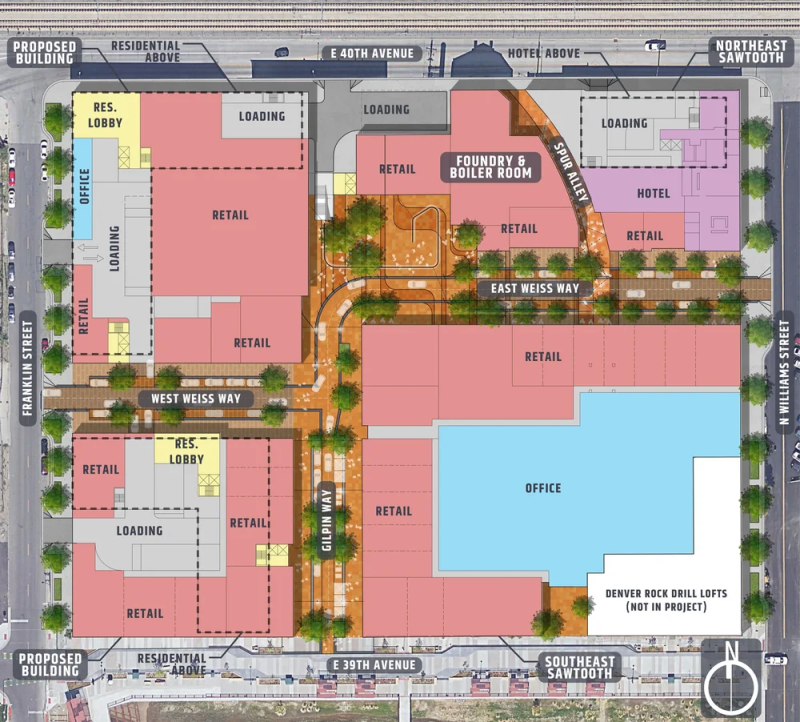
Image: Rock Drill RiNo
The $39M Question: TIF Does the Heavy Lifting
The financing is the real story here. Up to 7% of the cost, or $39M, is eligible for TIF reimbursement, expected to cover environmental remediation, rehabilitation of certain historic buildings and a publicly accessible plaza. Reimbursement is spread over as many as 25 years. The team has also engaged CDPHE’s voluntary cleanup program. Legacy industrial sites often carry costs that pure market economics can’t absorb, and this deal shows how urban renewal tools bridge that gap without carrying the whole project.
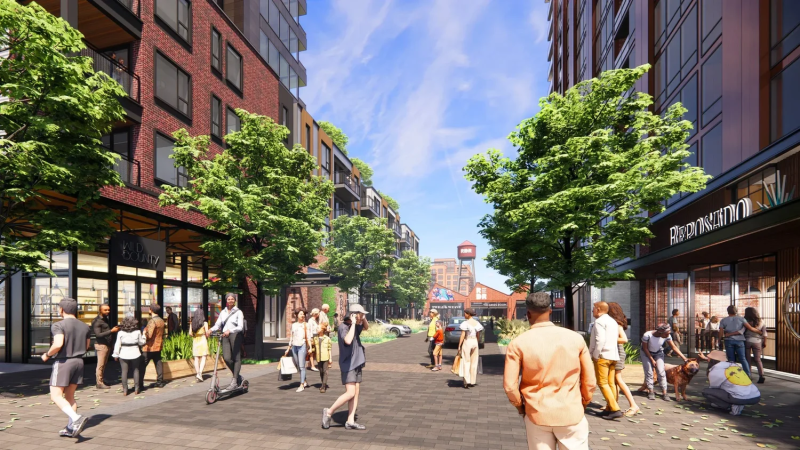
Preservation East, New Vertical West
The plan splits the site by purpose. The eastern portion is where historic preservation and adaptive reuse will be focused, with the new residential buildings on the west side and a hotel eyed for the northeast corner. The development agreement requires nearly a dozen industrial warehouse buildings to be registered under a historic designation. The developer intends to demolish much of the western portion to make room for new construction.
Central Plaza and East Weiss Way
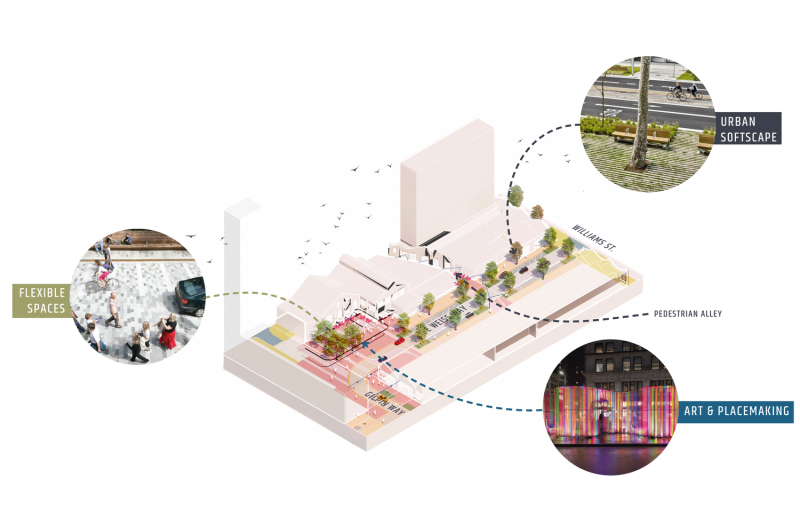
West Weiss Way
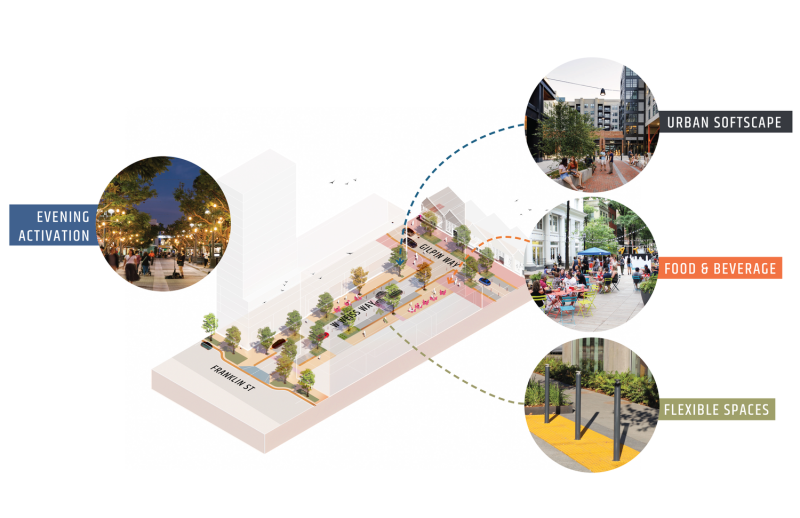
One note for anyone underwriting massing: reporting has varied on height, and some coverage cited a tower as tall as 22 stories, while the approved zoning is reported at up to 16 stories. Final building form will come through site plan review.
What to Watch Next
Remediation and landmarking. The developer is expected to move through design, remediation, local landmark designation for the preserved buildings and phased site development.
Timing. In 2025, the developer said construction could start the following year and that the plan was to build the whole project at once rather than in phases. We haven’t seen public confirmation of a groundbreaking as of this writing, so it’s worth tracking closely.
Retail and office leasing. The team is pursuing a grocer, and the developer has argued that the site’s unusual character could draw strong demand even in a challenged office market.
Why This Matters for Cole/RiNo CRE
Rock Drill adds another large, entitled node to a north Denver pipeline that includes Fox Park in Globeville, a 41-acre redevelopment with 1,000+ planned residential units. For owners, tenants and investors nearby, the combination of 700–800 new homes, neighborhood-serving retail and a possible grocer is a demand signal for the surrounding blocks. Historic adaptive reuse space is also a scarce, differentiated product that’s hard to replicate elsewhere.
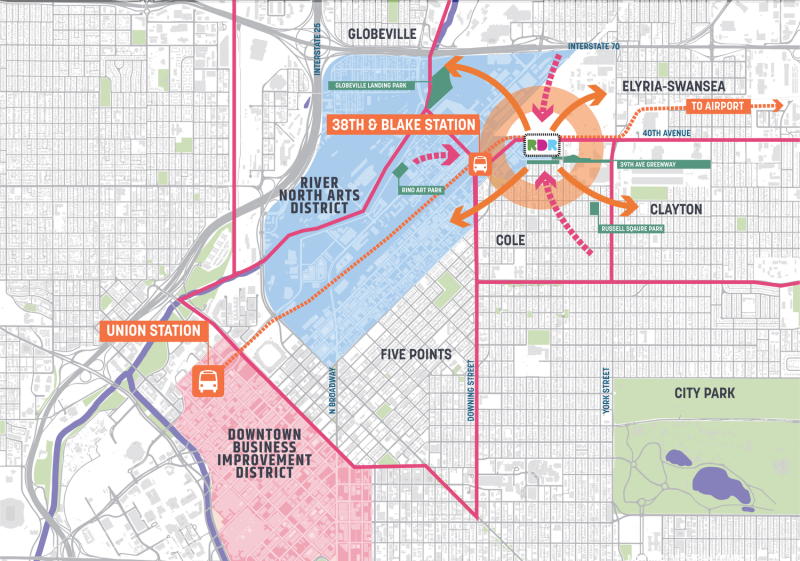
The takeaway: Entitlements are done and public financing is in place, so the open questions are timing, cost and tenant mix. For anyone active in Cole, RiNo or the broader north Denver corridor, Rock Drill is a site to watch through 2027 and beyond. For more Development Spotlights, see our breakdown of the Zebulon Regional Sports Complex and the Westwood community center proposal.
Evaluating a development or investment opportunity in north Denver? Talk to an SVN advisor about our development advisory services.