

Denver continues to stand out as one of the Mountain West’s most important commercial real estate markets, but Q2 2026 shows a metro moving through a meaningful period of adjustment. Across office, industrial, retail, and multifamily, the market is becoming increasingly selective as tenants, investors, and developers respond to changing supply and demand conditions.
Denver’s central location, established infrastructure, diversified economy, and long-term population growth continue to support its commercial real estate fundamentals. At the same time, recent development cycles have left certain sectors working through elevated supply. The result is a market where quality, location, basis, and timing matter more than the headline numbers alone.
Office
Tenants Hold the Advantage

Denver’s office market remains firmly tenant-favorable. Vacancy reached 18.2% in Q2 2026, while average market rents stood at $30.46 per square foot. Office properties were valued near $216 per square foot, with cap rates averaging 9.0%.
The pressure is not distributed evenly across the market. The CBD and aging office inventory continue to carry much of the vacancy burden as companies reduce footprints and become more selective about where they locate. Buildings offering efficient layouts, modern amenities, strong access, and a better tenant experience are increasingly positioned to outperform older properties competing primarily on price.
Limited speculative construction and increased demolition activity could gradually reduce supply pressure. While that does not signal an immediate office recovery, it may help move the market toward a healthier balance over time.
What we’re watching: The widening performance gap between modern, well-located office properties and older commodity space.
Industrial
Modern Facilities Are Winning the Competition for Tenants
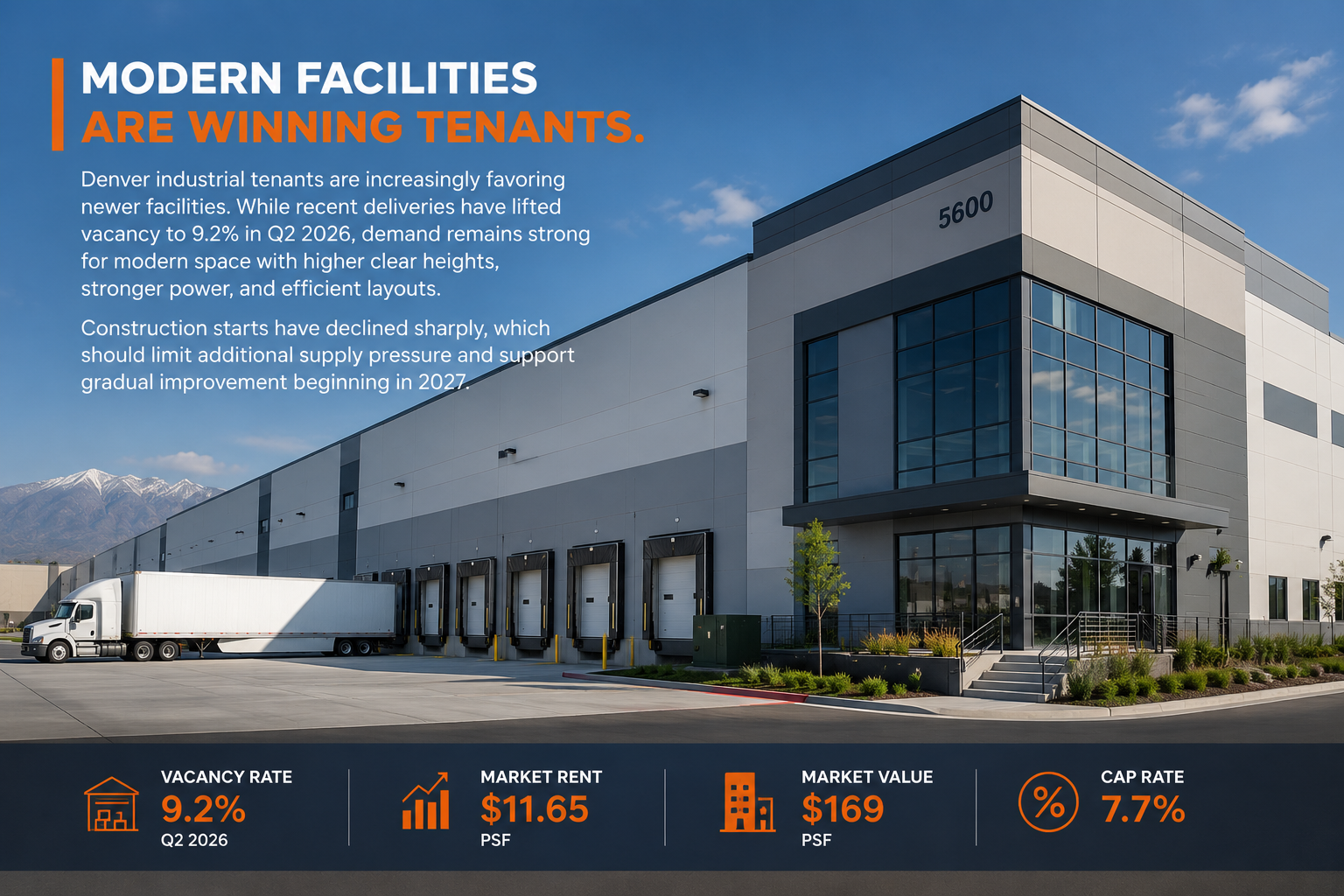
Denver’s industrial market is working through recently delivered supply. Vacancy reached 9.2% in Q2 2026, while average market rents stood at $11.65 per square foot. Industrial properties were valued near $169 per square foot, with cap rates averaging 7.7%.
Tenants are increasingly favoring newer facilities, leaving older inventory more exposed as the market absorbs recent deliveries. Assets with modern clear heights and stronger power capabilities are generating pockets of demand, particularly from aerospace and third-party logistics users. Meanwhile, increased tenant leverage across older properties is resulting in more concessions.
One encouraging signal is the development pipeline. Construction starts have declined sharply, which should limit additional supply pressure and support gradual improvement as existing inventory is absorbed. The report points toward the potential for broader market improvement beginning in 2027.
What we’re watching: The growing divide between modern industrial facilities and older inventory that may require repositioning, capital improvements, or more aggressive lease economics.
Retail
Limited Supply Keeps Fundamentals Tight
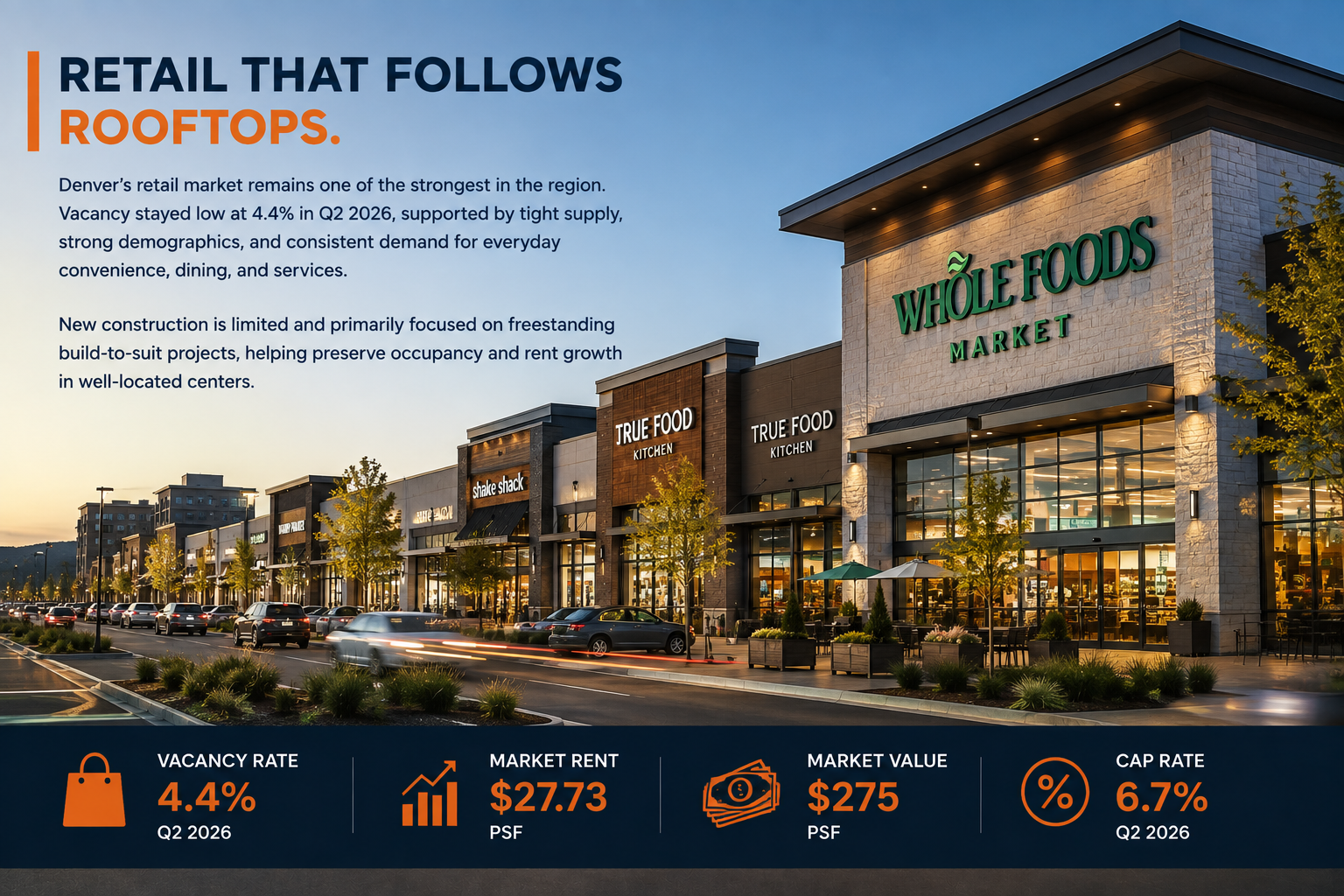
Retail remains one of Denver’s more resilient commercial real estate sectors. Vacancy stood at just 4.4% in Q2 2026, while average market rents reached $27.73 per square foot. Retail properties were valued near $275 per square foot, with cap rates averaging 6.7%.
Grocery-anchored centers, quick-service restaurants, and convenience-oriented suburban locations continue to outperform. Recent store closures and weaker downtown foot traffic have created localized softness, but the broader market remains tight.
Limited construction is helping maintain that balance. New development is primarily concentrated in freestanding build-to-suit projects, reducing the risk of significant new speculative supply. This constrained pipeline should help preserve relatively low vacancy, although slower population and employment growth could moderate tenant expansion across the metro.
What we’re watching: Convenience-oriented retail in growing residential areas, particularly locations where new rooftops are creating demand for restaurants, services, medical users, and other daily-needs concepts.
Multifamily
Denver Begins to Absorb Its Recent Supply Wave
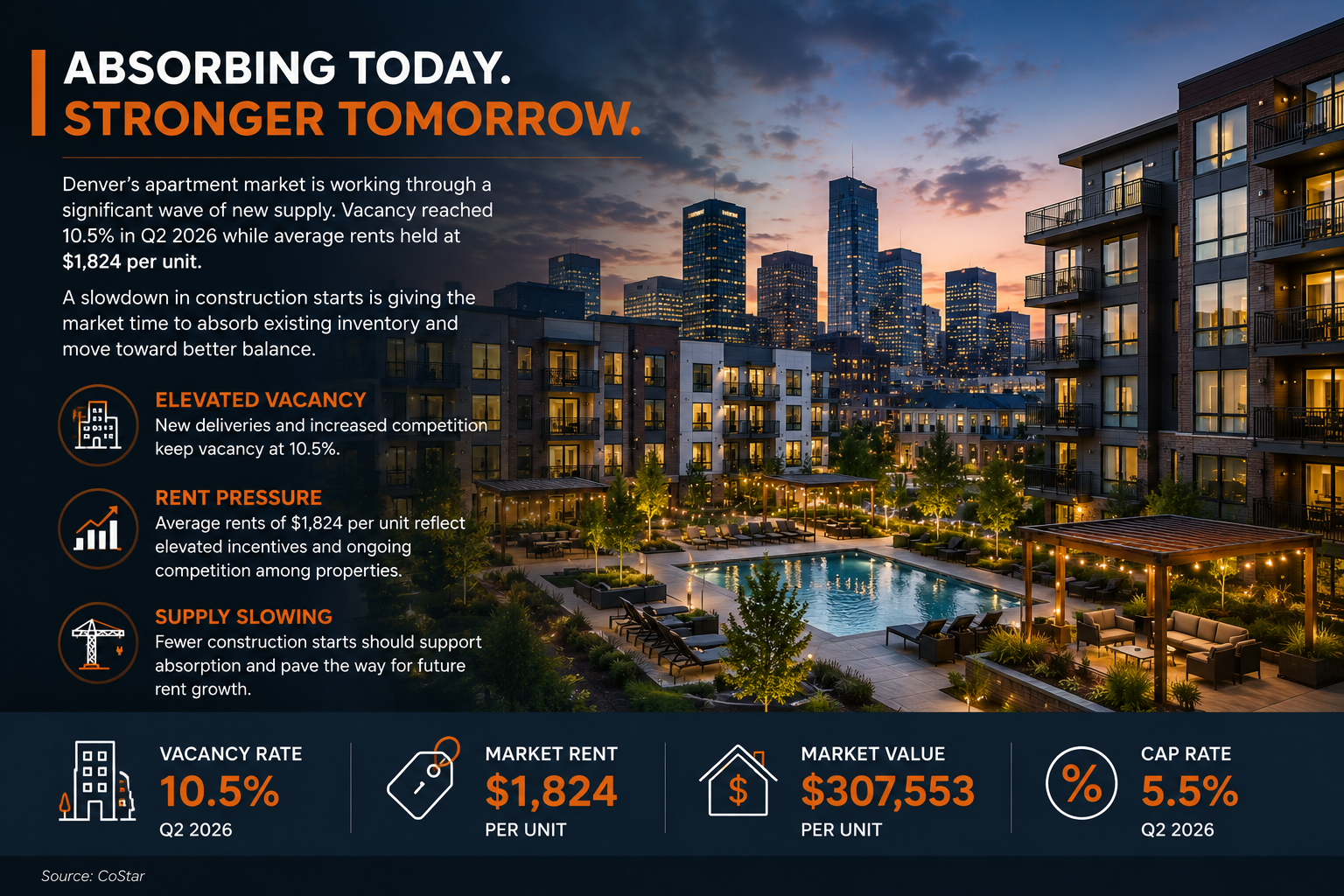
Denver’s apartment market is beginning to benefit from stronger renter demand and a pronounced slowdown in construction starts. Vacancy reached 10.5% in Q2 2026, while average market rents stood at $1,824 per unit. Multifamily assets were valued near $307,553 per unit, with cap rates averaging 5.5%.
Increased competition among properties has kept concessions widespread, particularly among newer luxury communities. That competition is also creating pressure for mid-tier properties as operators work to attract and retain renters.
The supply picture, however, is beginning to change. A reduced development pipeline should provide relief from the recent wave of deliveries and give the market time to absorb existing inventory. Even so, elevated vacancy and continued incentives are expected to delay meaningful rent growth until more of that supply is absorbed.
What we’re watching: The pace of absorption as Denver works through recently delivered units and a shrinking construction pipeline begins to change the supply-demand balance.
What This Means for Denver Commercial Real Estate
Denver is not moving through one commercial real estate cycle. Each major property sector is telling a different story.
Office continues to favor tenants as older inventory struggles with elevated vacancy. Industrial is recalibrating after a wave of new supply, with modern facilities increasingly separating themselves from aging product. Retail remains relatively tight, supported by limited construction and demand for convenience-oriented locations. Multifamily is still absorbing significant new inventory, but a shrinking development pipeline could gradually improve fundamentals.
Across all four sectors, one theme stands out: the market is becoming more selective.
For investors, that puts greater importance on acquisition basis, asset quality, submarket fundamentals, and future supply. For owners, maintaining a competitive property is increasingly important. For tenants, elevated availability in office and industrial may create opportunities to secure better space or negotiate more favorable economics.
Denver’s long-term advantages remain intact, but Q2 2026 points to a more disciplined phase of the cycle where opportunities are increasingly found property by property and submarket by submarket.
At SVN | Denver Commercial, we continue to track these shifts across the Denver metro to help owners, investors, developers, and tenants understand not only where the market stands today, but where opportunities may be emerging next.